
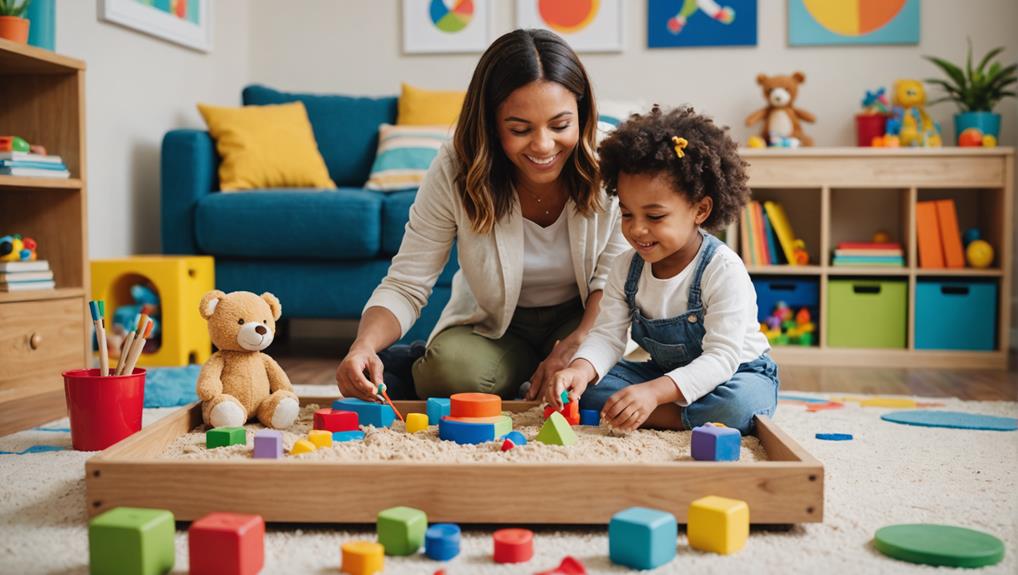
When children cannot express feelings with words, they use play to communicate. Play therapy also reinforces imagination and play. Therapists guide children through cooperative psychotherapy games, and they naturally communicate through play. These games also help them practice turn-taking, sharing, and working with others.
Using Communication Through Play
Children often communicate through their actions, and they use toys to show what is happening inside. Play therapy provides a safe space for this expression. A trained therapist understands the child’s symbolic language. While the child plays, the therapist observes and interacts. This helps build a trusting relationship. For many children, using words to describe what they feel or think is hard. Play offers a natural way to express thoughts without the pressure of finding the right words. In play psychotherapy, a child’s choices of toys, art supplies, or games can provide clues to concerns or worries. Therapists watch for patterns or themes in the play, which inform how they support each child.
Therapists might notice a child acting out certain scenarios, or they could be using the same toys in specific ways. These repeated actions often point to situations the child thinks about. Open-ended play lets children show what matters to them at that moment. The therapist responds in ways that encourage further communication. Sometimes, a child invites the therapist to join the game. Through this shared play, the therapist mirrors the child’s actions, listens carefully to their words, and provides gentle prompts.
Developing Healthy Coping Skills
Play helps children learn to solve problems. They try different solutions in a safe setting. Therapists help children develop new coping skills. This practice supports growth. It helps children use these strategies when they face challenges. During play therapy sessions, children experiment with ways to handle difficult situations. They might work through scenarios that mirror challenges they have faced at home, school, or with friends. By role-playing these scenarios, children practice responses and solutions in a non-judgmental environment. This makes it easier to try new approaches. Therapists provide gentle guidance, and the children work through different options. If a child is feeling overwhelmed or frustrated, the therapist introduces a calming activity or suggests a new way to approach a problem.
Building New Skills in Psychotherapy
Play therapy supports a child’s ability to invite new siblings. Children engage with tasks and activities provided by the therapist. The therapist offers positive reinforcement and acknowledges small achievements, so the child sees progress in their actions. These skills apply in other settings outside of therapy. In the playroom, children make choices, organize play sequences, and set their own pace. This helps them learn valuable decision-making skills because each action has a direct, visible result. Choosing which toy to use or how to build a structure encourages children to think ahead. By following their own ideas, children practice setting goals and working toward completing them. Therapists design activities that encourage children to use different strategies or approaches when facing small obstacles during play.
Support Your Child
Since your role in your child’s therapy is valuable, support the process. Maintain open communication with the therapist. Ask questions about your child’s progress and learn how you can help at home. Your partnership with the therapist creates a consistent support system for your child.

Gynecology is a medical specialty focused on the health of [...]

When you experience pain or an injury in your foot [...]
When children cannot express feelings with words, they use play [...]

Back pain affects the spinal structures significantly, and this can [...]

Back and neck conditions cover a wide range of medical [...]

An annual physical exam is a routine medical appointment designed [...]

Weight loss involves reducing total body mass to improve health [...]

Cardiology focuses on the diagnosis, prevention, and management of conditions [...]